Beef dim sum is a category, not one translucent dumpling. Steamed beef balls are shaped minced meat, often sitting on bean-curd skin; beef-filled rice rolls wrap filling in a soft rice sheet. A wrapped beef dumpling is another preparation and should be identified by its actual wrapper and menu name.
Identify the form before choosing a recipe
- Steamed beef balls: rounded sticky mince, with no dumpling wrapper surrounding each ball. A bean-curd sheet underneath is a base, not a translucent starch skin.
- Beef rice rolls: a broad cooked rice sheet rolled around filling. Their texture depends on both the sheet and the cooked filling.
- Wrapped beef dumplings: enclosed parcels whose dough can differ by recipe. Do not call every beef parcel har gow; that name normally denotes a shrimp dumpling.
Let’s Cook Chinese Food’s illustrated beef-ball recipe shows the first form. The small home batch below simplifies its raw-beef treatment; it is not a claim of a tested restaurant reproduction.
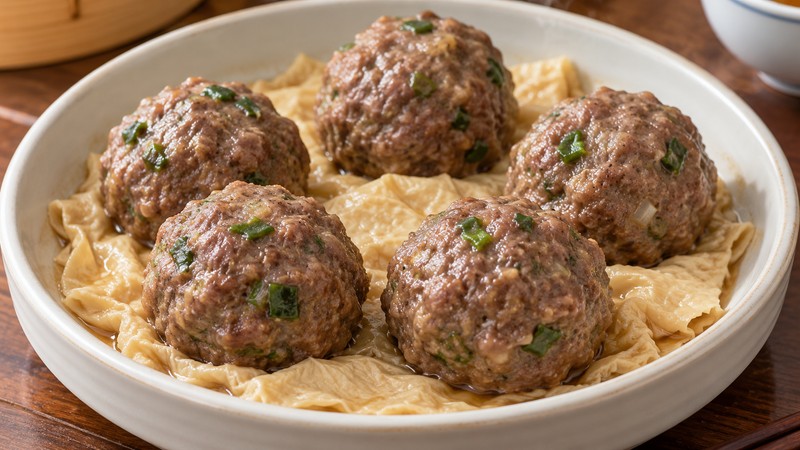
A six-ball home adaptation
Use 160 g finely minced beef, 20 g finely chopped pork fat, 1 finely chopped water chestnut, 1 sprig chopped coriander and about 1 teaspoon finely chopped softened dried mandarin peel. Season with 1/2 teaspoon light soy, 1/2 tablespoon oyster sauce, 1/2 teaspoon each Shaoxing wine and bouillon, 1/2 tablespoon cornstarch, 1 tablespoon water, a little white pepper and a few drops sesame oil. Have one bean-curd sheet, soaked until pliable and drained.
This version omits the source’s baking-soda/sugar pretreatment and raw-meat rinse, so the texture differs. Do not replace the missing pretreatment by adding its full baking soda quantity directly to finished ground meat. Soy, oyster sauce, sesame and the pork fat all matter when checking dietary restrictions.
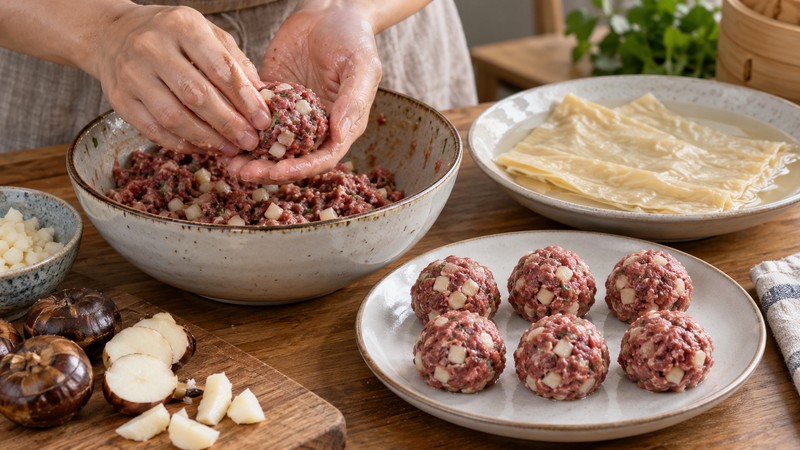
Make sticky mince, then steam to a measured center
Mix meat and seasonings until cohesive, then fold in the finely chopped additions. Cover and chill for at least half a day as in the primary method. Divide into six equal balls on the softened bean-curd base in a rimmed heatproof plate, leaving gaps. Keep waiting batches refrigerated.
Set above boiling water, cover and start checking around 10 minutes. Ground beef and pork require 160 F (71 C), according to FoodSafety.gov. Probe the center of a large ball and continue cooking if needed. A springy exterior is not a doneness test; serve only once the center is cooked.
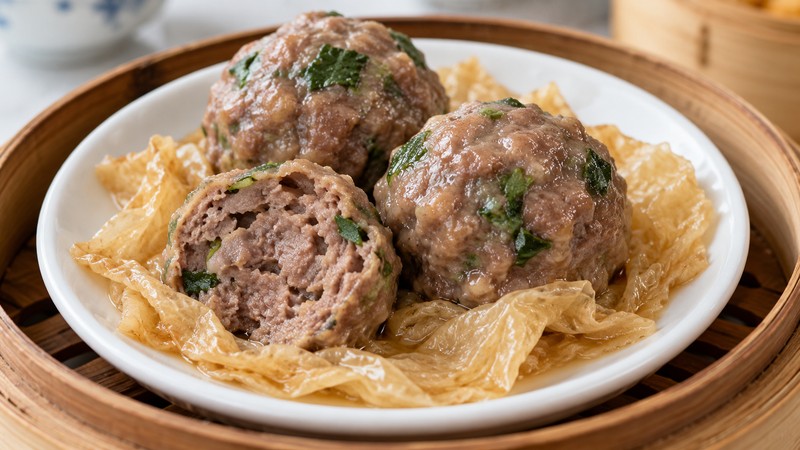
Choose the next dim sum project by wrapper
For a rice-sheet project compare shrimp rice rolls; for an open egg wrapper see siu mai. Those methods cannot share an automatic steaming timer with beef balls. If ordering rather than cooking, ask what the filling contains: a beef label does not guarantee a pork-free dish, and a bean-curd base does not make it vegetarian.
Frequently Asked Questions
Does the bean-curd sheet wrap each beef ball?
Not in the preparation described here. It lies beneath the balls as a base. Wrapped bean-curd rolls are a separate form.
Can I use this filling inside a rice roll?
Treat that as a separate recipe. Filling thickness and the surrounding sheet change cooking; measure the meat center rather than borrowing the beef-ball timer.
AI-generated illustrations, if used, are not photographs of a tested batch.