Quick Answer: Cantonese soy chicken, often called see yao gai, is chicken gently poached and steeped in a seasoned soy liquid. The practical keys are a pot narrow enough to keep the bird mostly submerged, a quiet simmer rather than a hard boil, and a thermometer check at the thickest part before serving. The braising liquid gives the chicken its savory-sweet color; it is not the same method as pale white-cut chicken served with a separate ginger-scallion dip.
Soy Sauce Chicken and White-Cut Chicken Use Different Liquids
Both dishes use gentle poaching, but the liquid and finish differ. Cantonese soy chicken cooks in a seasoned soy-based braising liquid, which colors the skin and seasons the meat. White-cut chicken is poached in a much plainer liquid and is commonly served with a ginger-scallion condiment. The Woks of Life describes soy sauce chicken as a Cantonese favorite cooked with soy sauce, aromatics, and spices; Adam Liaw likewise identifies a soy-braised version as Cantonese-style lo sui.
That difference changes what to watch. With soy chicken, the liquid must be deep enough for even contact and should not reduce aggressively while the bird cooks. With a plain poach, there is no dark soy liquid to manage. For a different Cantonese chicken method, see the site’s Cantonese salt-baked chicken guide.
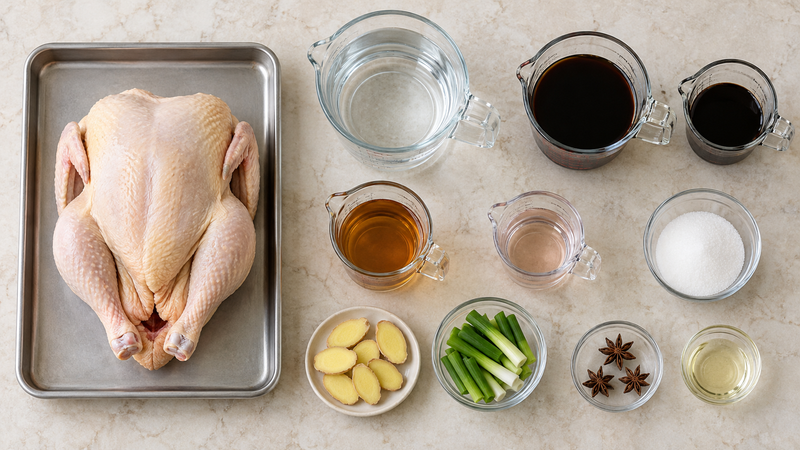
Ingredients for a Whole-Chicken Soy Poach
This is a home adaptation of the large-batch, whole-bird method published by The Woks of Life. It is not a separately kitchen-tested Yue Cuisine recipe. The source’s bath is intentionally generous so a roughly 4-pound (1.8 kg) chicken can fit in a tall, narrow pot. This adaptation keeps the source’s other listed bath quantities but omits its 1/4 cup salt and its raw-chicken rinse/salt-rub step to follow current CDC handling guidance. That omission changes the source formula and has not been separately kitchen-tested. If your pot needs more liquid, scale the listed seasonings and water together rather than topping up with plain water alone.
| Ingredient | Starting amount | Purpose |
|---|---|---|
| Whole chicken, about 4 lb / 1.8 kg | 1 | Choose a bird that fits the pot with room to lower and lift it safely |
| Water | 12 cups / about 2.8 L | Base for a large poaching bath |
| Light soy sauce | 2 cups | Salty, savory seasoning |
| Dark soy sauce | 1/2 cup | Deeper color and a rounder soy note |
| Shaoxing wine | 3/4 cup | Aromatic cooking wine |
| Mei gui lu (Chinese rose wine), optional | 3/4 cup | A fragrant option used in the source version; substitute more Shaoxing wine if unavailable |
| Sugar | 1 3/4 cups | Balances the large salty liquid and contributes to the glossy finish |
| Ginger, sliced | 7 slices | Warm aromatic base |
| Scallions, cut into short lengths and lightly crushed | 2 | Fresh allium aroma |
| Star anise | 3 whole | Warm spice aroma |
| Neutral oil | 2 teaspoons | To start the ginger and scallion |
Apart from the disclosed salt omission, the ingredient amounts above follow the scale of the cited large-batch source rather than a low-sugar reformulation. Soy sauces vary in saltiness, and the poaching liquid is not meant to be consumed as a bowl of soup. For a smaller bird or a pot that needs less liquid, scale the listed bath proportionally and verify doneness by temperature, not by time alone.
Prepare the Braising Liquid Before Adding the Chicken
Remove the giblets and pat the chicken dry with disposable paper towels. Do not rinse raw chicken: CDC guidance says it is ready to cook, while washing can spread germs around the sink and nearby surfaces. Wash your hands with soap and water for at least 20 seconds after handling it, keep the chicken and its tools separate from ready-to-eat food, and clean contacted utensils and surfaces with hot, soapy water before the next task.
Choose a tall, narrow pot that fits the bird closely. The pot size matters: a wide pot needs more liquid to cover the chicken, which means the seasoning quantities must increase too. The Woks of Life notes that the bird should be submerged and that its recipe quantities need to rise proportionally when a larger pot is used.
Warm the oil over medium-low heat. Add ginger and let it sizzle briefly, then add the scallions. Add the star anise and wine; bring the mixture to a simmer. Stir in the light soy, dark soy, sugar, and water, then simmer the liquid gently for about 20 minutes so the aromatics infuse it. Avoid reducing it to a sticky glaze at this stage.
Lower the Chicken and Keep the Heat Gentle
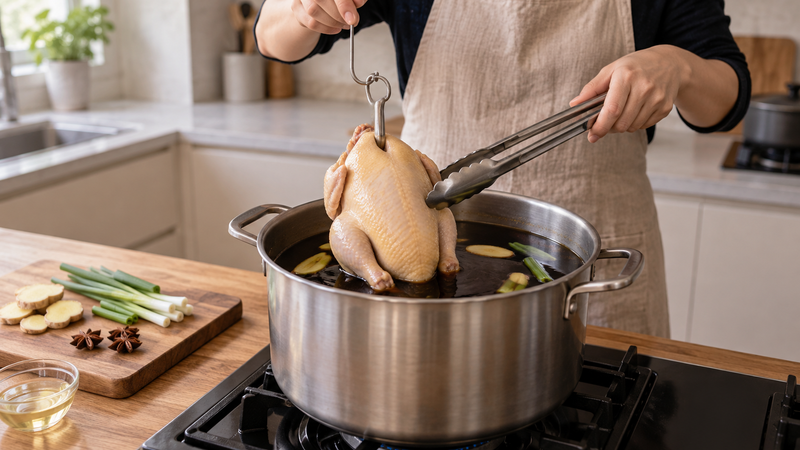
Lower the chicken into the hot liquid breast-side up, using sturdy tongs or another safe lifting tool. Keep your face and hands clear of splashes. If the cavity traps air, carefully lift and tilt the bird so the cavity fills with liquid. The chicken should be mostly submerged; baste any exposed area with a ladle of hot liquid or turn the bird once partway through.
Let the pot return to a lazy simmer, then cover it. The surface should move gently, not churn. A hard boil can agitate the skin and makes it harder to control the cooking. The source method uses about 25 minutes at a very gentle simmer followed by covered steeping off the heat; the exact time changes with bird size, starting temperature, and pot conditions.
Turn off the heat and leave the covered chicken in the liquid for roughly 15 to 25 minutes, using the shorter or longer end as a timing estimate, not a safety test. Check the thickest part of the thigh with a food thermometer. USDA’s home-cooking guidance is to cook poultry to at least 165°F (74°C). If the reading is lower, return the pot to gentle heat and check again. Do not rely on clear juices, skin color, or a timer alone to establish doneness.
Rest, Carve, and Use the Sauce Carefully
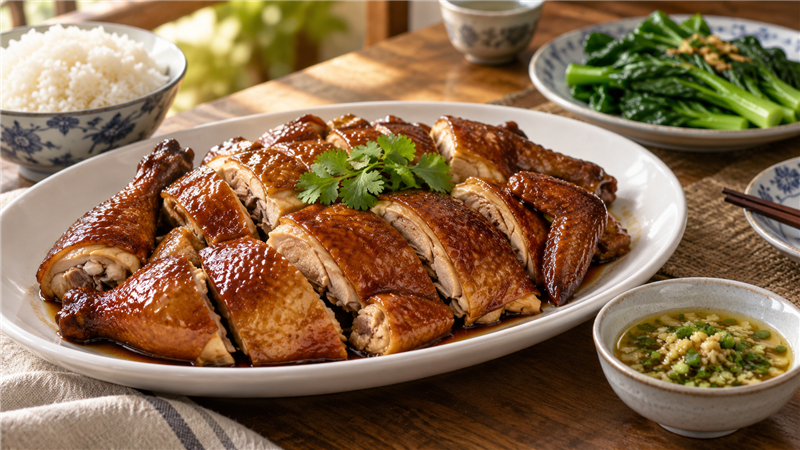
Lift the chicken onto a clean tray and let it rest for 10 to 15 minutes before chopping or carving. Spoon a little strained braising liquid over the pieces for serving, or offer it separately so diners can control the saltiness. Serve with rice and a simply cooked green vegetable; the site’s Cantonese cooking-method guide covers other gentle-heat methods and timing choices.
The dark liquid can be strained and frozen for possible later use, as both The Woks of Life and Adam Liaw describe for their own preparations. Treat it as a perishable cooked-food liquid: cool it promptly in shallow containers, refrigerate or freeze it, and reheat it thoroughly before reuse. Because it has contacted raw chicken, do not taste it before it has been brought to a full boil. Discard it if storage time or handling is uncertain. Each reuse changes its salt, sweetness, and concentration, so taste only after reheating and adjust cautiously.
Common Problems and What to Check
| Result | Likely process issue | Next check |
|---|---|---|
| Pale patches | The bird sat above the liquid or was not basted/turned | Use a closer-fitting pot and baste exposed areas |
| Skin splits or looks rough | The liquid boiled vigorously or the bird was handled roughly | Lower the heat and lift with a stable tool |
| Meat near the bone is underdone | The bird was larger or colder than the timing assumed | Verify with a thermometer in multiple thick spots and continue gentle cooking if needed |
| Liquid tastes too salty | Soy brands or reduction changed the balance | Do not reduce the bath hard; serve a small amount as sauce and dilute only after cooking if needed |
| Meat seems dry | The chicken cooked too long or at too high a heat | Use the timer as a prompt to check temperature, not as an automatic finish signal |
FAQs
Is Cantonese soy chicken roasted?
The common method described here is a soy-braised or gently poached chicken, even though soy chicken may be sold beside roast meats. It is the seasoned liquid and the gentle cook that define this home method, not oven roasting.
Can I use chicken legs instead of a whole chicken?
Yes, but smaller pieces cook faster and need less liquid. Use a proportionate amount of braising liquid and check each piece with a thermometer; do not reuse whole-bird timing as a fixed rule.
Why use both light and dark soy sauce?
In the cited source method, light soy provides much of the savory seasoning while dark soy deepens the color. Brands differ, so the final taste and color will not be identical from kitchen to kitchen.
Can I make the braising liquid less sweet?
The source’s whole-bird formula uses a large volume of liquid and sugar. A reduced-sugar version is an adaptation rather than the same tested formula; change the amount cautiously and taste the cooked sauce, not the raw liquid, before serving.
Is Cantonese soy chicken the same as white-cut chicken?
No. Both can use gentle poaching, but soy chicken cooks in seasoned soy liquid while white-cut chicken is generally cooked in a plain or lightly seasoned liquid and served with a dip.
Sources and Further Reading
- Soy Sauce Chicken: A Chinatown Classic, The Woks of Life — whole-bird ingredients, pot fit, gentle simmer, steeping, thermometer check, and braising-liquid handling.
- Soy Sauce Chicken with Spring Onion Oil, Adam Liaw — Cantonese-style lo sui framing and a chicken-piece variation.
- USDA FSIS: Chicken from Farm to Table — minimum internal-temperature guidance for poultry.
- CDC: Chicken and Food Poisoning — raw-chicken separation, handwashing, no-rinse guidance, surface cleaning, and the 165°F thermometer boundary.
- FoodSafety.gov: Leftovers—The Gift that Keeps on Giving — two-hour refrigeration, shallow-container cooling, and 165°F reheating guidance.
- Continue with the site’s Cantonese cooking techniques, Cantonese food resource center, and Cantonese cooking guide when comparing methods and ingredients.