Quick answer
Air fryer char siu works best when pork shoulder is cut into even strips, marinated in a Cantonese-style sweet-savory sauce, cooked with space around each piece, and glazed near the end so the sugar does not scorch. Treat the time in any recipe as a starting range because air fryers vary. For a whole cut of pork, verify at least 145°F/63°C in the thickest part and rest it for 3 minutes, following USDA guidance.
Basic facts
| Item | Working range |
|---|---|
| Pork cut | Boneless shoulder or collar with some marbling |
| Strip size | About 1½ inches / 4 cm thick and evenly shaped |
| Marinating time | 8–24 hours, refrigerated |
| Starting air-fryer setting | 360°F / 182°C |
| Approximate cook time | 18–26 minutes, depending on thickness and appliance |
| Safety check | At least 145°F / 63°C, then rest 3 minutes |
| Yield | About 4 servings from 1½ lb / 680 g pork |
What changes when char siu moves from oven to air fryer
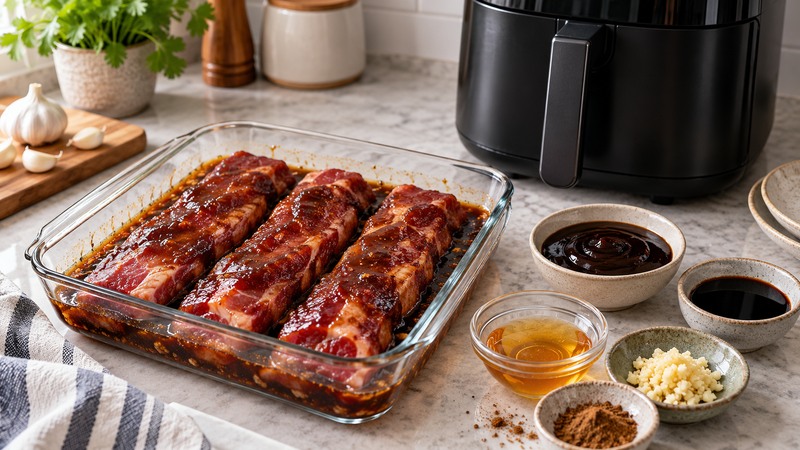
An air fryer circulates hot air in a small chamber. That can color the surface quickly, but a sweet glaze can darken before a thick strip is cooked through. The practical adjustment is to cook most of the pork with only the marinade coating that clings to it, then apply a separate clean glaze during the final minutes.
This version is an air-fryer adaptation of Cantonese barbecue pork rather than a claim that a countertop appliance reproduces a siu mei shop's hanging roast. For the oven method and broader ingredient context, see our Cantonese char siu recipe.
For another comparison of cut, marinade, and conventional roasting, use the BBQ pork char siu guide before deciding which method fits your kitchen.
Ingredients for four servings
Pork and marinade
- 1½ lb / 680 g boneless pork shoulder or collar
- 2 tablespoons hoisin sauce
- 1 tablespoon light soy sauce
- 1 teaspoon dark soy sauce
- 1 tablespoon Shaoxing wine, or dry sherry
- 1 tablespoon honey
- 1 teaspoon toasted sesame oil
- 1 teaspoon minced garlic
- ½ teaspoon Chinese five-spice powder
- ¼ teaspoon white pepper
Separate finishing glaze
- 1 tablespoon honey
- 1 tablespoon hoisin sauce
- 1 teaspoon warm water
Mix the finishing glaze in a clean bowl and keep it separate from raw pork and its marinade. This avoids brushing raw-meat marinade onto pork at the end of cooking. USDA guidance says used marinade must be boiled before it is brushed onto cooked pork; using a separate portion is simpler.
Step-by-step method
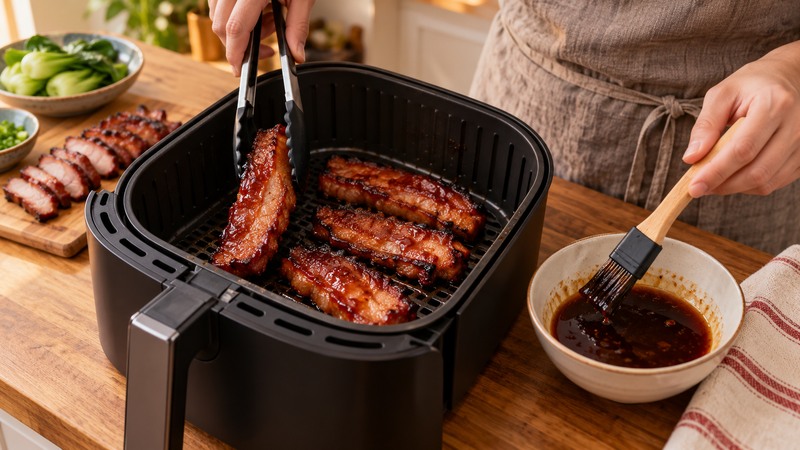
1. Cut the pork evenly
Cut across very large muscles as needed to make two or three long strips, each close to 1½ inches / 4 cm thick. Even thickness matters more than exact length because it helps the pieces finish at similar times. Trim only hard exterior fat; a little marbling helps the meat tolerate high circulating heat.
2. Marinate under refrigeration
Combine the marinade ingredients. Coat the pork, cover it, and refrigerate for 8–24 hours. Keep raw pork and its liquid away from ready-to-eat food. When ready to cook, lift out the strips and let excess marinade drip back into the container. Discard that liquid unless you bring it to a full boil before another use.
3. Preheat and arrange the basket
Follow the appliance manual if it specifies preheating. A useful starting setting is 360°F / 182°C. Lightly oil the basket if sticking is common, then arrange the pork in one layer with space between strips. Do not crowd or stack them.
4. Cook, turn, and check early
Air fry for 9 minutes, turn with clean tongs, then cook another 7 minutes. Begin checking the thickest part of each strip with a food thermometer. If it has not reached 145°F / 63°C, continue in 2–3 minute intervals. Appliance power, basket shape, starting temperature, and strip thickness all affect timing.
5. Glaze near the end
When the pork is close to the target temperature, brush a thin layer of the separate finishing glaze over the top. Cook 1–2 minutes, turn, glaze the second side, and cook another 1–2 minutes. Watch closely: honey and hoisin can move from glossy to scorched quickly.
6. Rest before slicing
Remove the pork after the thickest part of each strip reaches at least 145°F / 63°C. Rest it for at least 3 minutes, then slice against the grain. The USDA notes that color alone is not a reliable doneness test, so use the thermometer rather than judging the pink center or clear juices.
Timing guide by strip thickness
| Approximate thickness | First check | Likely total range | What decides completion |
|---|---|---|---|
| 1 inch / 2.5 cm | 13 minutes | 15–20 minutes | Thermometer reading and glaze color |
| 1½ inches / 4 cm | 16 minutes | 18–26 minutes | Thermometer reading in thickest piece |
| 2 inches / 5 cm | 20 minutes | 24–32 minutes | Temperature; reduce heat if glaze darkens early |
These are planning ranges, not fixed safety instructions. Check each batch because models differ, as USDA's air-fryer guidance also emphasizes.
How to avoid dry pork or burned glaze
- Use shoulder or collar: very lean tenderloin has less margin for error.
- Keep the strips even: thin ends can burn while the center catches up.
- Delay the finishing glaze: sugar needs only a short final exposure.
- Leave room for airflow: crowding can produce uneven color and timing.
- Check temperature early: continuing far past the safe minimum can dry the meat.
- Clean between raw and cooked handling: use a clean plate, brush, and tongs for finished pork.
If you want to compare sauce proportions before cooking, our char siu sauce guide explains the roles of hoisin, soy sauce, sweetener, and aromatics.
Serving and storing
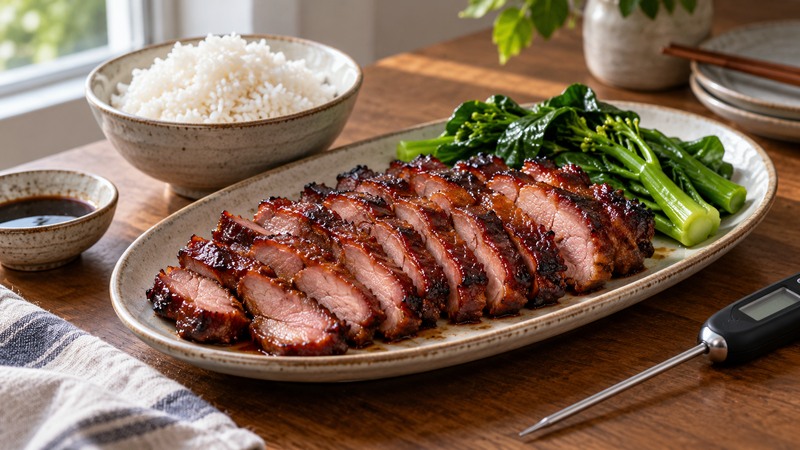
Serve the sliced pork with steamed rice and blanched greens, or use it in fried rice and noodles. Refrigerate leftovers within 2 hours, or within 1 hour if the ambient temperature is above 90°F / 32°C. Reheat leftovers to 165°F / 74°C, the USDA minimum for leftovers, and add a spoonful of water before reheating if the slices seem dry.
Frequently asked questions
What temperature should I air fry char siu?
Use 360°F / 182°C as a starting appliance setting, then adjust for your machine and strip thickness. The food-safety endpoint is separate: whole-cut pork must reach at least 145°F / 63°C and rest for 3 minutes.
Can I put char siu sauce on at the beginning?
The marinade coating can remain on the pork, but a heavy honey-rich finishing glaze is better applied near the end. This reduces scorching while the center cooks.
Can I reuse the raw pork marinade as glaze?
Only after boiling it, according to USDA guidance. A simpler option is to mix and reserve a clean finishing glaze before it touches raw pork.
Why is my air fryer char siu dry?
Common causes are very lean pork, uneven or overly thin strips, or cooking well beyond the required temperature. Use a thermometer and begin checking before the recipe's upper time limit.
Can I make this with chicken?
Chicken needs its own timing and safety endpoint. All poultry must reach 165°F / 74°C. Do not use the pork temperature as the endpoint for chicken.