Asian steamed salmon is a home adaptation of Cantonese ginger-scallion steaming using salmon portions. It is not a claim that salmon is the original banquet fish. The practical checks are fillet thickness, a safe center temperature and a light finishing sauce.
Ginger and scallion provide a savory aromatic finish. The fillet recipe below uses moderate seasoning and checks the fish center.
What Is Asian Steamed Salmon?
This recipe applies a Cantonese-style steaming and aromatic finish to salmon. It is a home adaptation rather than a universal definition of Asian salmon.
Historically, Cantonese chefs used this technique for high-quality white fish like garoupa (grouper) or sea bass, reserved for special occasions such as Lunar New Year, family reunions, or wedding banquets. The word for fish in Chinese (“yu”) sounds identical to the word for “surplus,” making steamed fish a symbol of abundance and good fortune.
Salmon is a practical substitution when it is available locally. Cut thickness still matters; its fat does not prevent overcooking.
Choose fish in good condition and handle it safely; no comparison of salmon and white-fish prices is assumed.
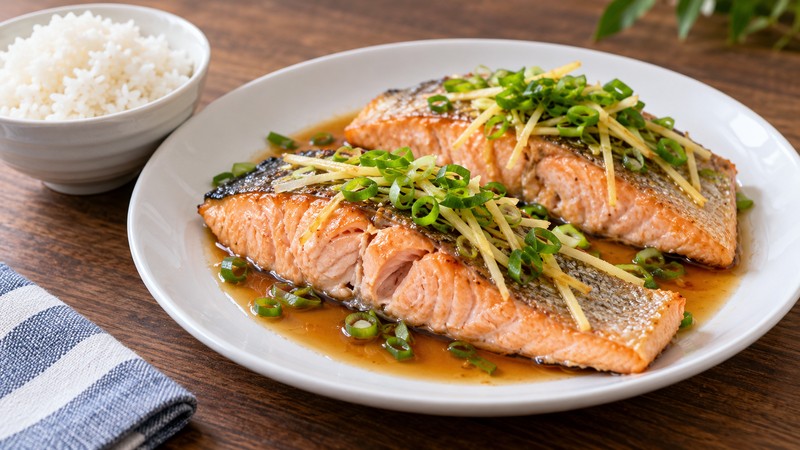
Cantonese-Style Salmon at Home
This is an adapted portion recipe, not a claim of an original traditional salmon dish or a tested preparation.
Ingredients for Two
- 2 salmon portions, 170 g (6 oz) each, about 2.5 cm (1 inch) thick, pin bones removed
- 10 g fresh ginger, half sliced and half julienned; 2 scallions, sliced
- 1 tablespoon light soy sauce, 2 tablespoons water and 1/4 teaspoon sugar
- 1 teaspoon sesame oil and 1 tablespoon neutral oil
- 1 teaspoon Shaoxing wine, optional; rice to serve
- Keep salmon chilled until ready. Put portions skin-side down on a heatproof plate, topped with sliced ginger and some scallion; add optional wine.
- Bring water beneath a steamer rack to a boil. Set the plate above the water, close the lid and maintain steam.
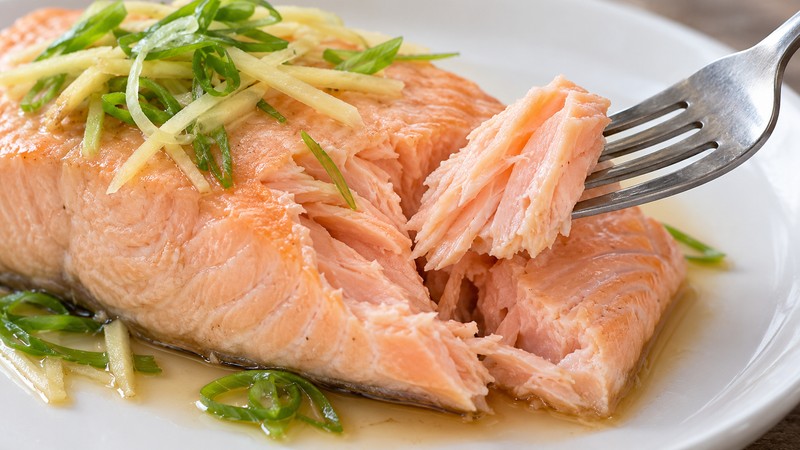
- Start checking around 8 minutes, but do not use the clock as proof of doneness. The center must reach 145 F (63 C); continue cooking as needed. The flesh should also separate easily. Different thicknesses take different times.
- Remove the plate with mitts and drain excess liquid carefully. The skin stays soft, not crisp.
- Gently warm the neutral oil in a skillet and cook the remaining ginger and scallion until fragrant. Add soy, water, sugar and sesame oil, heat through and spoon over the salmon. Do not heat the oil until it smokes.
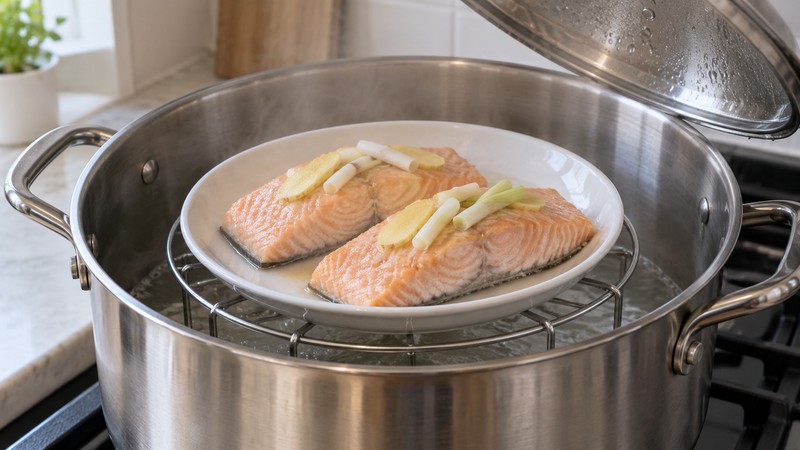
Asian Steamed Salmon Variations
Portion thickness changes cooking time. Oyster sauce or a little citrus can be optional flavor changes, not verified regional requirements.
At home, a skillet-warmed aromatic finish is practical. Fish quality and a center check matter more than a claim that wild fish or exact-minute steaming is always superior.
Additional mushrooms or vegetables need preparation and cooking checks of their own; do not pile raw toppings over the salmon and assume the same cook.
Serving Asian Steamed Salmon the Cantonese Way
Serve skin-side down on a stable plate, as in the steaming method, with sauce over the flesh.
Rice and a vegetable side work well. The recipe does not need a tableside smoking-oil performance.
Avoid oversteaming and heavy sauce. Drain enough excess liquid to keep the finish from becoming watery.
Frequently Asked Questions
Can I use frozen salmon?
Yes. Thaw in the refrigerator and pat dry. Do not assume the old steaming time still applies; check the center.
Can I keep the skin on?
Yes, skin-side down on the plate. Steaming will not crisp it, so remove it at the table if you prefer.
Do I have to pour smoking oil over it?
No. The skillet-warmed ginger and scallion finish below avoids that step while keeping the aromatic flavor.
Keeping Leftovers
Refrigerate perishable cooked food promptly in shallow containers, within two hours of cooking (one hour above 90 F / 32 C). Keep it cold at 40 F / 4 C or below. USDA generally allows three to four days for refrigerated leftovers; discard food left out too long. Reheat leftovers to 165 F (74 C), checking the center rather than relying on a few seconds or minutes.
Sources and Related Reading
Primary salmon technique and context source. The home adaptation above is not presented as an exact copy of that author’s recipe or as a recipe tested by YueCuisine. Food-safety temperature and handling guidance; USDA leftover guidance.
Asian Steamed Sea Bass: Cantonese Timing, Sauce, and Texture Checks · How to Make Asian Steamed Egg Recipe: The Authentic Cantones
Any newly generated food visuals accompanying this article are AI illustrations, not photographs documenting a kitchen test. Retained existing images are captioned only for their visible contents and context.