Barbecue pork steamed buns combine a yeast dough with cooled, saucy cooked char siu. Allow enough time for both rises; the dough condition matters more than a promised ninety-minute total.
Known as char siu bao, these buns are a familiar yum cha dish. Their appeal is the contrast between soft dough and sweet-savory roast-pork filling; there is no supported daily sales count here.
What Is Barbecue Pork Steamed Buns?
Char siu bao belongs to Cantonese dim sum. This recipe is a home-style steamed bun, not a claim to reproduce a particular nineteenth-century teahouse formula.
The steamed bun format was ideal: it was filling, affordable, and could be customized with local ingredients. Over time, char siu pork—Cantonese barbecued pork marinated in honey, five-spice, and soy—emerged as the star filling, thanks to its bold, approachable flavor.
Char siu bao can be steamed or baked. Char siu sou is a flaky pork pastry, not the name of baked bao.
Its popularity has led to regional adaptations, but the core of sweet dough and saucy char siu filling remains consistent across traditional Cantonese preparations.
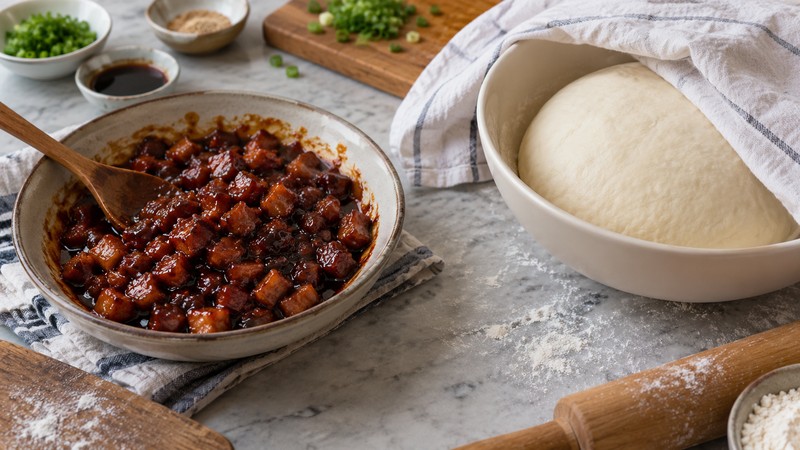
Dough and Filling
Keep the cooked filling cool and thick enough to scoop without leaking. Either a bamboo or metal steamer can be used; leave space around the liners for steam circulation.
Ingredients for Eight Buns
Dough: 2 cups all-purpose flour, 1 tsp instant yeast, 2 tbsp granulated sugar, 1/2 cup warm whole milk, 1 tbsp lard or vegetable shortening, and 1/4 tsp baking powder. These are the existing home-version proportions; use the linked published dough recipe rather than assuming identical restaurant texture.
Filling: 1 cup shredded cooked char siu pork, 2 tbsp hoisin sauce, 1 tbsp oyster sauce, 1 tsp light soy sauce, 1/2 tsp dark soy sauce, 1 tsp granulated sugar, 1 tsp cornstarch, 2 tbsp cold water, 1/4 tsp each Chinese five-spice and white pepper, 1 tsp rice vinegar and 1 tsp toasted sesame oil.
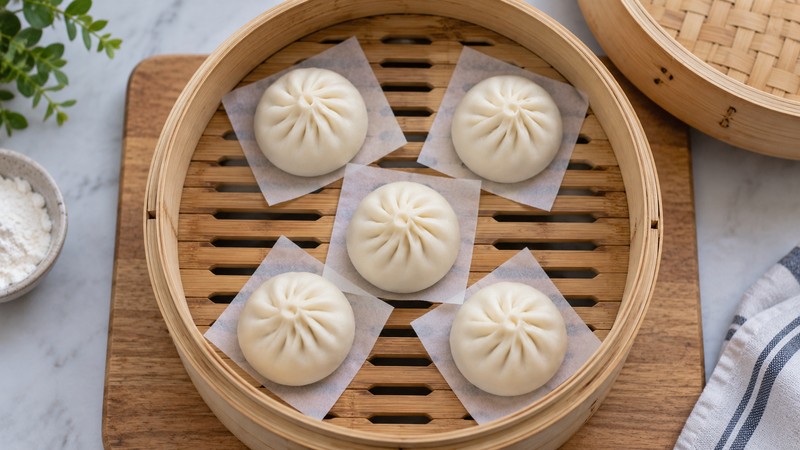
Step-by-Step Instructions
- Prepare the filling: In a small bowl, mix cornstarch and cold water to create a smooth slurry. Heat a small pan over medium-low heat, then add hoisin, oyster, light and dark soy, sugar, five-spice, white pepper, and rice vinegar.
- Stir continuously for 1 minute until the sugar dissolves, then add the slurry. Cook for another 1 minute until the sauce thickens, then remove from heat.
- Mix in shredded char siu and sesame oil, then set aside to cool completely.
- Use instant yeast according to its package directions; it does not need to foam in milk to prove that it is usable.
- Mix and knead the dough: Whisk the 2 cups flour, 1 tsp instant yeast, 2 tbsp dough sugar and 1/4 tsp baking powder together. Add the 1/2 cup milk and 1 tbsp lard or shortening, then mix to form a dough. No separately activated yeast mixture is used.
- Use your hands or a stand mixer with a dough hook to knead for 5-7 minutes until the dough is smooth, elastic, and no longer sticky.
- Cover and let the dough rise in a comfortably warm place until expanded and airy. Room temperature and yeast strength change the time.
- Divide into eight equal portions. Roll discs with a thicker center and thinner edges, without promising a 50 g weight for every portion.
- Portion the filling: Place 2 tbsp of the cooled char siu filling in the center of each dough circle. Avoid overfilling, as this can cause the buns to leak or burst during steaming.
- Fold overlapping pleats and pinch to close. The number of pleats is not a safety or authenticity requirement.
- Second proof: Cut 8 small squares of parchment paper, each with a tiny hole poked in the center. Place each shaped bun on a parchment square, then arrange them in a bamboo steamer (leave 1 inch of space between each bun to allow for expansion).
- Cover the steamer and let the buns rise for 15-20 minutes until they feel puffy and light to the touch.
- Steam over boiling water until the dough is cooked and the cooked-pork filling reaches 165 F (74 C). Do not stop at exactly eight minutes if the buns still need cooking.
- Turn off the heat, then let the buns sit in the covered steamer for 2 minutes before lifting the lid—this prevents the buns from collapsing due to sudden temperature change.
Variations
While the core char siu bao recipe is rooted in Cantonese tradition, regional and stylistic variations have emerged across Chinese communities. The most notable divide is between Hong Kong style and mainland Cantonese style.
Beyond regional differences, home and restaurant versions also vary. Professional dim sum restaurants sometimes add a small amount of dough conditioner or extra baking powder to their dough to achieve a lighter, fluffier texture for large batches, while home cooks often adjust the sweetness to taste—some add a pinch of salt to balance the sugar, while others swap lard for vegan shortening for plant-based versions.
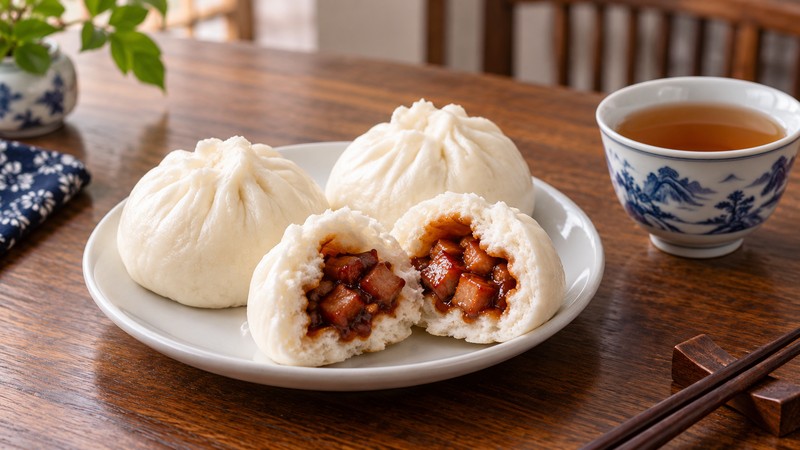
Serving the Cantonese Way
Traditional Cantonese serving etiquette for char siu bao centers on keeping the buns warm and pairing them with complementary flavors. Buns are served in small bamboo steamer baskets, usually 2-3 per order, to retain heat during the meal.
Serve the buns pleated-side up. Tea is an optional accompaniment; choose a tea you enjoy rather than treating one variety as essential.
Common mistakes when serving or preparing char siu bao include over-steaming, which makes the dough soggy and dense, and skipping the second proof, which leads to flat, tough buns. Sealing the buns too loosely is another error—pinching the pleats firmly is critical to prevent filling from leaking during steaming.
Bamboo or metal steamers are suitable. Refrigerate leftovers promptly and reheat the filling to 165 F (74 C); a fixed three-minute resteam does not establish that temperature.
Recipe References
Published recipe and technique reference; FoodSafety.gov cooking temperatures.
Related recipes: Char siu filling; Bean curd rolls.
AI-generated illustrations, where added, show recipe concepts rather than photographs of a tested cooking session.